The Story Behind CanisCore
How one mischievous Sheltie, three decades of learning and a simple question led to the creation of CanisCore.
It All Started With Dali
People sometimes ask me how I became a dog trainer. The truth is, I never set out to become one.
Like so many people, I simply wanted to do the very best for my own dog.
My first dog was a Shetland Sheepdog called Dali, and as a young puppy he was incredibly destructive around the house. I did what most new owners do – I bought books, read everything I could get my hands on and tried my best to follow the advice.
The problem was that the books were very good at telling me what I should be teaching... But they didn't really tell me what to do when things didn't go to plan. When Dali shredded something he shouldn't. When he made choices I wasn't expecting. Or when I found myself wondering whether I was getting it right at all.
So I did what I now encourage so many other owners to do.
I found a local dog training club and enrolled in their puppy classes. I went along hoping to learn how to train my dog and how to correct him when things went wrong.
What I didn't realise at the time was that it would completely change the direction of my life. As I learned more about dogs, I found myself becoming fascinated not just by how they learn, but by why they behave the way they do and how we, as owners, can build better relationships with them through understanding, communication and trust.
That curiosity has never really gone away.
More than thirty years later, I'm still learning, still asking questions and still looking for better ways to help owners enjoy life with their dogs. And in many ways, CanisCore is simply the next chapter of that journey.
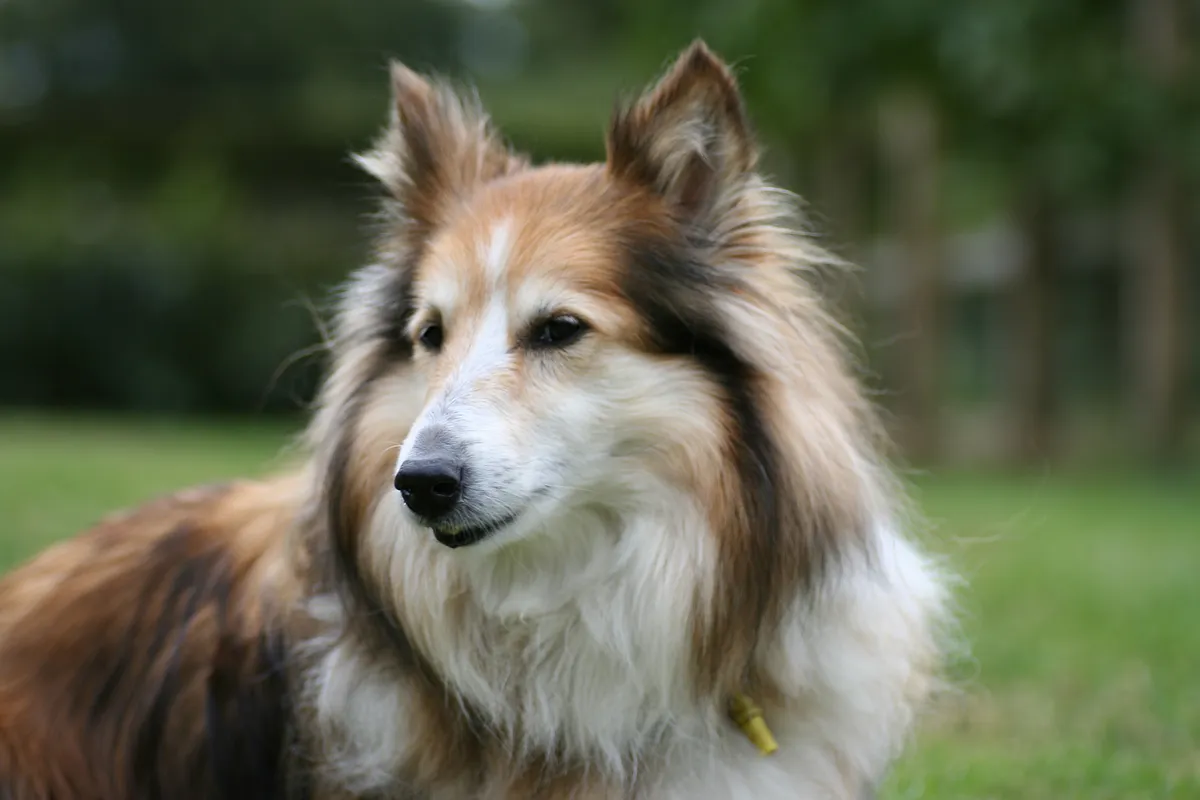
Looking back now, I sometimes smile because, without realising it, Dali was teaching me the very lesson that would eventually lead to CanisCore. Dog owners don't just need information. They need guidance, encouragement and support when real life doesn't quite go according to plan.
The Challenge Has Changed
Back then, in the early nineties, things were very different. The internet wasn't something you could turn to for instant answers, so if you wanted to learn more, you either found yourself searching through dog training books at the local library or looking for a dog training club where you could learn from someone with more experience.
In many ways, finding information was much harder than it is today. But there was another side to that.
You weren't constantly bombarded with hundreds of different opinions telling you that one method was right and another was wrong. Fast forward to today, and we've almost got the opposite problem. Information is everywhere. Sadly, much of that advice contradicts itself.
Today there are thousands of videos, websites and social media accounts all telling you how to train your dog. And that makes it harder than ever to know which advice to trust, and that takes me right back to the question I asked myself all those years ago when I was struggling with Dali.
"Where do I go for advice I can trust?"
Thirty years later, I realised that many dog owners are still asking exactly the same question.
That's one of the reasons creating CanisCore means so much to me. I wanted to create the kind of guidance I believe every dog owner should have access to: a place where you don't have to second-guess every decision because the advice is based on experience, understanding, and a genuine desire to help you build a better relationship with your dog.
The Best Trainers Never Stop Learning

The more I learned about dogs, the more I realised just how much there was still to learn.
What started with one puppy soon became a lifelong passion for understanding not just how dogs learn, but why they behave the way they do and how we can build stronger relationships through better communication.
Over the years I've been fortunate enough to work with thousands of dogs and their owners. Every puppy, every adolescent, every rescue dog and every behavioural case has taught me something new. In many ways, the dogs have been every bit as important to my education as the courses I've studied.
I've always believed that if I'm asking owners to trust me with one of the most important relationships in their lives, then I have a responsibility to keep learning too.
That journey led me to complete the COAPE Advanced Diploma in Companion Animal Behaviour and Training, graduating with distinction, and I've continued investing in my professional development ever since because our understanding of dogs never stands still.
That qualification wasn't the end of my learning—it was simply another step on the journey.
The science evolves. Our understanding of dogs evolves. And I believe good trainers should evolve with it. Not because the latest idea is always the best one, but because every new piece of research helps us understand our dogs a little better.
I've never been interested in collecting certificates for the sake of it. Every course I've completed, and every book I've read, has had one purpose: to help me better understand dogs so I can better support the people who trust me to help them.
At the heart of everything I do is a simple belief:
The day I stop learning is the day I stop becoming a better teacher for the people and dogs who put their trust in me.
The Dog That Changed Everything
People often ask me where Fun | Focus | Play came from.
The truth is, I never sat down one day and decided to create my own training approach. It actually came about because one of my own dogs presented me with a problem I simply couldn't solve.
When Luna had her final litter, I decided to keep one of the puppies. That puppy was Cassie.
As it happened, two of her brothers stayed with me much longer than I had originally planned. One eventually left when he was around eleven weeks old, but Nico stayed until he was nearly nineteen weeks old. Looking back now, I got to experience littermate syndrome first-hand, something I'd never had to deal with before.
Cassie and Nico developed an incredibly close bond with each other.
I knew the risks, so I did everything I would normally advise anyone raising two puppies together to do. I made sure they spent time apart, trained them individually and worked hard to build a relationship with each of them. In fact, I did everything I'd always done with my own puppies as well.
But with Cassie... something was different.
When Nico finally left for his new home, it became obvious that despite everything I'd tried, Cassie hadn't really bonded with either me or Paul in the way I'd hoped. She lacked confidence and, for the first time in a long time, I found myself in a situation where my usual approach wasn't working.
That was a difficult thing to admit.
Not because I thought I'd failed, but because I realised Cassie was teaching me something I didn't yet understand.
So I did what I've always done whenever I don't have an answer. I went looking for one.
I read everything I could get my hands on. I looked at the research. I tried different approaches. I observed Cassie carefully, and perhaps most importantly, I listened to what she was telling me instead of assuming I already knew the answer.
Slowly, things started to change.
Not because I found one magic exercise, but because I began looking at our relationship differently. Instead of asking, "How do I get Cassie to do this?" I found myself asking, "How can I help Cassie want to work with me? How can I become the person she chooses to engage with?"
Looking back now, I can see that those months with Cassie changed the way I thought about dog training forever.
The ideas that eventually became Fun | Focus | Play all started there.
They weren't created overnight, and they certainly weren't invented in front of a whiteboard. They evolved over time through working with Cassie, refining those ideas with the thousands of owners and dogs I've worked with since, and constantly asking myself one simple question:
"How can I make learning more enjoyable, more meaningful and more rewarding for both ends of the lead?"
As those ideas continued to develop, I eventually brought many of them together in my book, No Pulling Allowed. It was my first opportunity to share this way of thinking with owners beyond my own training classes.
Today, that same philosophy runs through everything I do. It's at the heart of my classes, my books and, of course, CanisCore.
You'll Never Train Alone.
One of the things Cassie taught me was that I'd been asking myself the wrong question.
For years I'd been helping people teach their dogs to sit, lie down, come back when they were called and all the other things we naturally want our dogs to learn. There wasn't anything wrong with that, but as I worked through everything Cassie and I were struggling with, I realised I kept coming back to the same thought.
"I'm not sure it's the behaviour that's the problem."
It wasn't that she couldn't learn. She was a very bright, driven dog with a work ethic I hadn't experienced before, and she was perfectly capable of doing the exercises I was asking her to do. What I began to realise was that she didn't always understand what I was trying to communicate to her, and that made me wonder whether I'd been looking at training from the wrong angle all along.

Instead of asking myself, "How do I teach this behaviour?" I found myself asking a completely different question.
"How do I help my dog understand what I'm trying to communicate?"
The more I thought about that question, the more everything else seemed to fall into place. I realised that I wasn't really trying to teach dogs a collection of behaviours at all. What I was really trying to do was help them understand ideas and concepts that would make those behaviours meaningful.
And that is the moment I realised I was onto something: because when we're only focused on teaching behaviours, we're almost teaching the dog to perform them on autopilot rather than helping them understand what we're trying to communicate.
Instead, I started to wonder, "What if I gave her a choice, and then encouraged her to make the right choice?"
The more I thought about it, the more it made sense. If I could help Cassie discover that making good choices led to wonderful things happening, then she wasn't simply learning a behaviour, she was beginning to understand a concept. She wasn't just responding to me because I'd asked her to do something; she was actively thinking about the choices she was making.
Once I started looking at training that way, everything began to change. Instead of trying to teach one behaviour after another, I found myself teaching the ideas that sit underneath those behaviours. Helping dogs learn how to make good choices, showing them that thinking is more rewarding than simply reacting, and helping them discover that paying attention to their owner opens the door to all sorts of wonderful things.
Once those foundations are in place, the individual behaviours become much easier because they're built on understanding rather than repetition.
At the same time, something else started to happen that I hadn't really expected.
As I began giving Cassie more opportunity to think for herself and discover that making good choices led to wonderful things happening, our relationship started to change.
I wasn't asking her to do something because I told her to. I was guiding her towards the answer and giving her the opportunity to choose it for herself. If she made the wrong choice, that wasn't a failure, it simply meant we had a "do over" and tried again.
The more we trained that way, the more engaged she became. Training stopped feeling like something I was doing to her and became something we were doing together. Looking back now, I honestly think that was the biggest lesson Cassie ever taught me.
As I started sharing the same ideas with the owners I worked with, I noticed the same thing happening again and again. Training became more enjoyable because both owner and dog were learning together. Owners became more relaxed, dogs became more engaged, and almost without anyone noticing, their relationship became stronger too.
That's when I realised I hadn't simply changed the way I trained dogs. I'd changed the way I helped people build relationships with them.
People often ask me where the "Play" comes in. It's a fair question because it isn't about entertaining dogs for the sake of it or turning training into one long game. The games simply became the easiest way I'd found of helping dogs explore, think, experiment and discover things for themselves. Before I knew it, owners were enjoying training more, the dogs were enjoying training more and everyone was learning together.
Looking back now, I think that's what Fun | Focus | Play has always been about. Not teaching dogs a long list of behaviours, but helping dogs and the people who love them understand one another a little better. Because when a dog truly understands what we're trying to communicate, everything else starts to fall into place. Communication becomes clearer, trust grows naturally, and before you know it you've built something far more important than a collection of behaviours. You've built a relationship.
Why CanisCore Exists
Over the years I've often found myself wondering how I could help more people than I could ever reach through my face-to-face classes.
The obvious answer was to move online, but every time I looked at the training apps already available, I kept coming away with the same feeling.
Most of them were simply libraries of training videos. You signed up, watched the lessons and then you were expected to get on with it by yourself.
That just didn't sit comfortably with me. Because that's never how I've taught.
Whether I'm standing on a training field with someone or talking to them from the other side of a computer screen, I've always wanted to be actively involved in helping them succeed. I don't just want to show someone what to teach. I want to answer their questions, celebrate their progress, help them work through the bits they're finding difficult and guide them when things don't quite go to plan.
In other words, I wanted my online students to receive the same level of support as the people who come and train with me in person.
During Covid, when face-to-face classes weren't possible, I found myself doing exactly that. It proved to me that it was possible to support people remotely without losing that personal connection, and that's when the idea of creating an app first began to take shape.
The trouble was, I couldn't find an app that worked the way I wanted it to.
So earlier this year I finally decided to stop looking for one. Instead, I decided to build it.
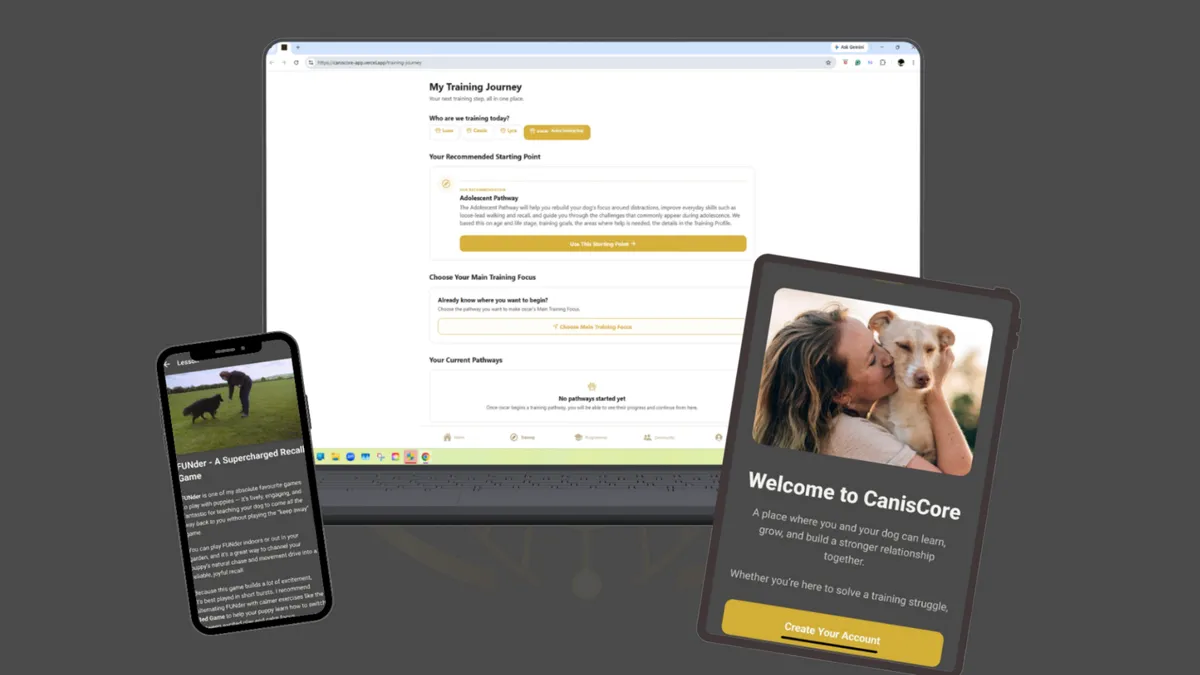
CanisCore isn't an app that was created because I wanted to build software. It exists because that's what I've always wanted CanisCore to be. Not another library of training videos, but somewhere owners know they have someone walking alongside them, especially when things don't quite go to plan.
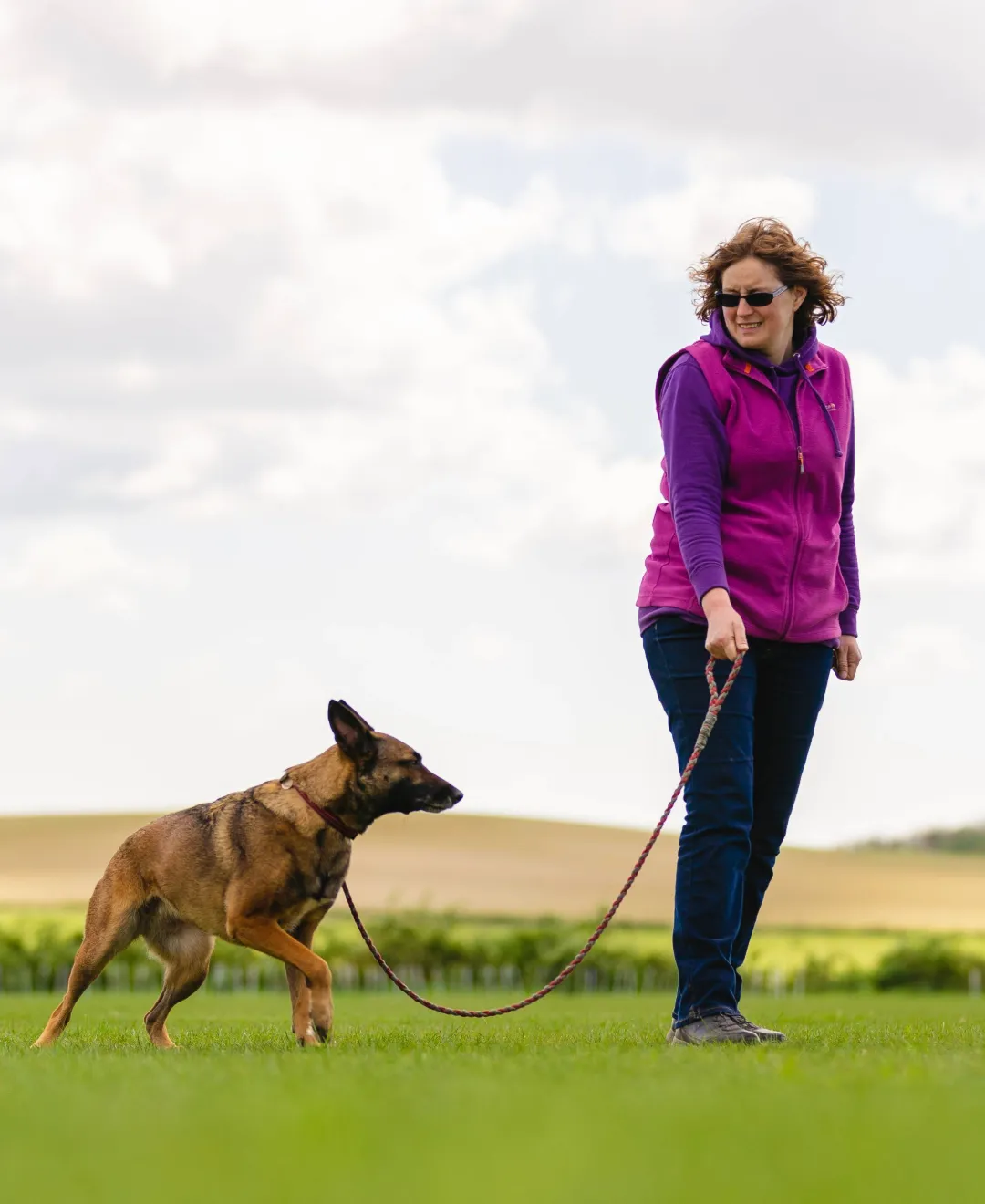
If you've read this far, then hopefully you'll have realised that CanisCore isn't simply another dog training app. It's my way of helping more dog owners experience the same guidance, encouragement and support that my in-person clients receive every week.
If that sounds like the kind of support you've been looking for, I'd love to welcome you into the CanisCore community.

Follow us


